
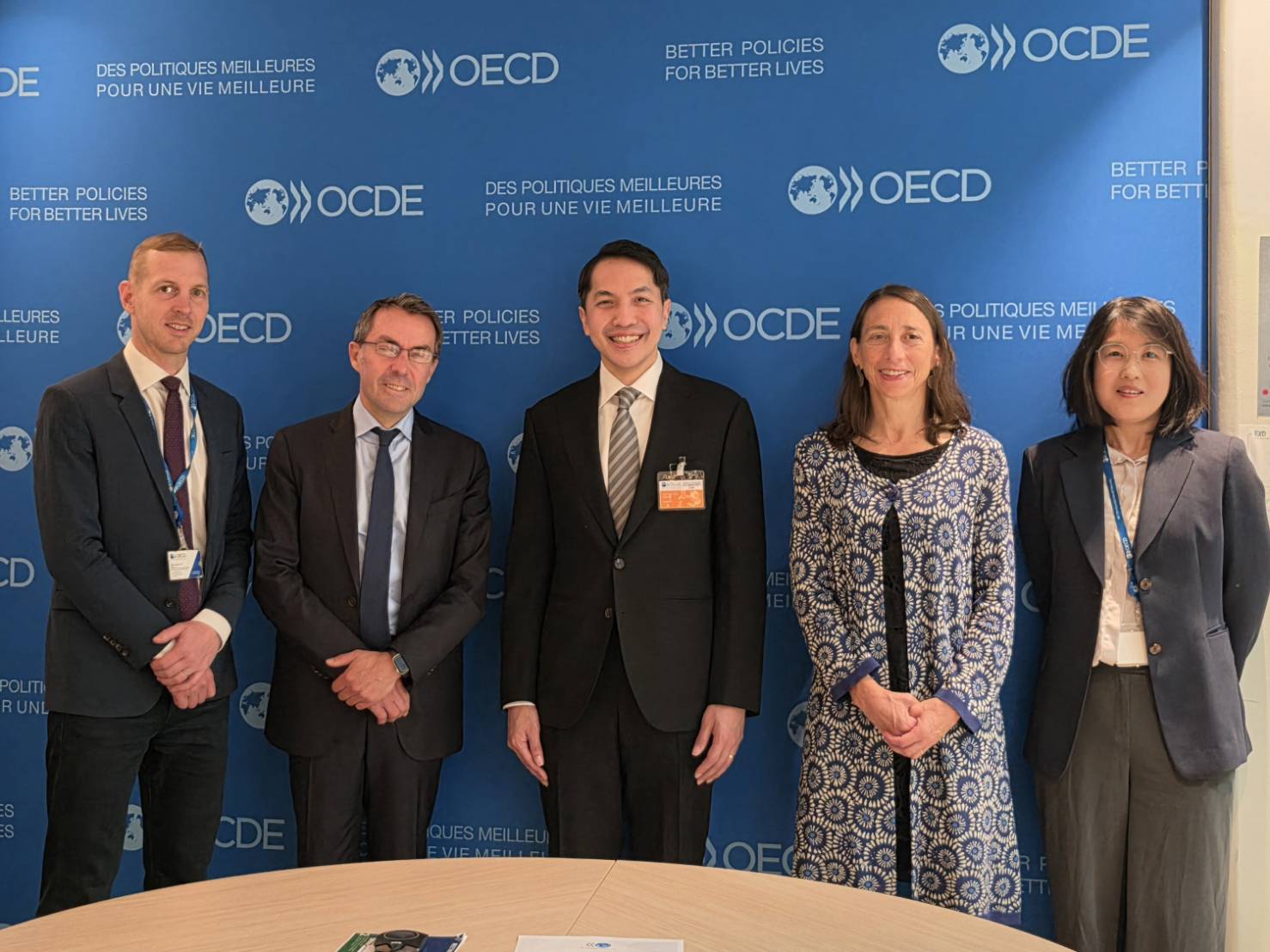
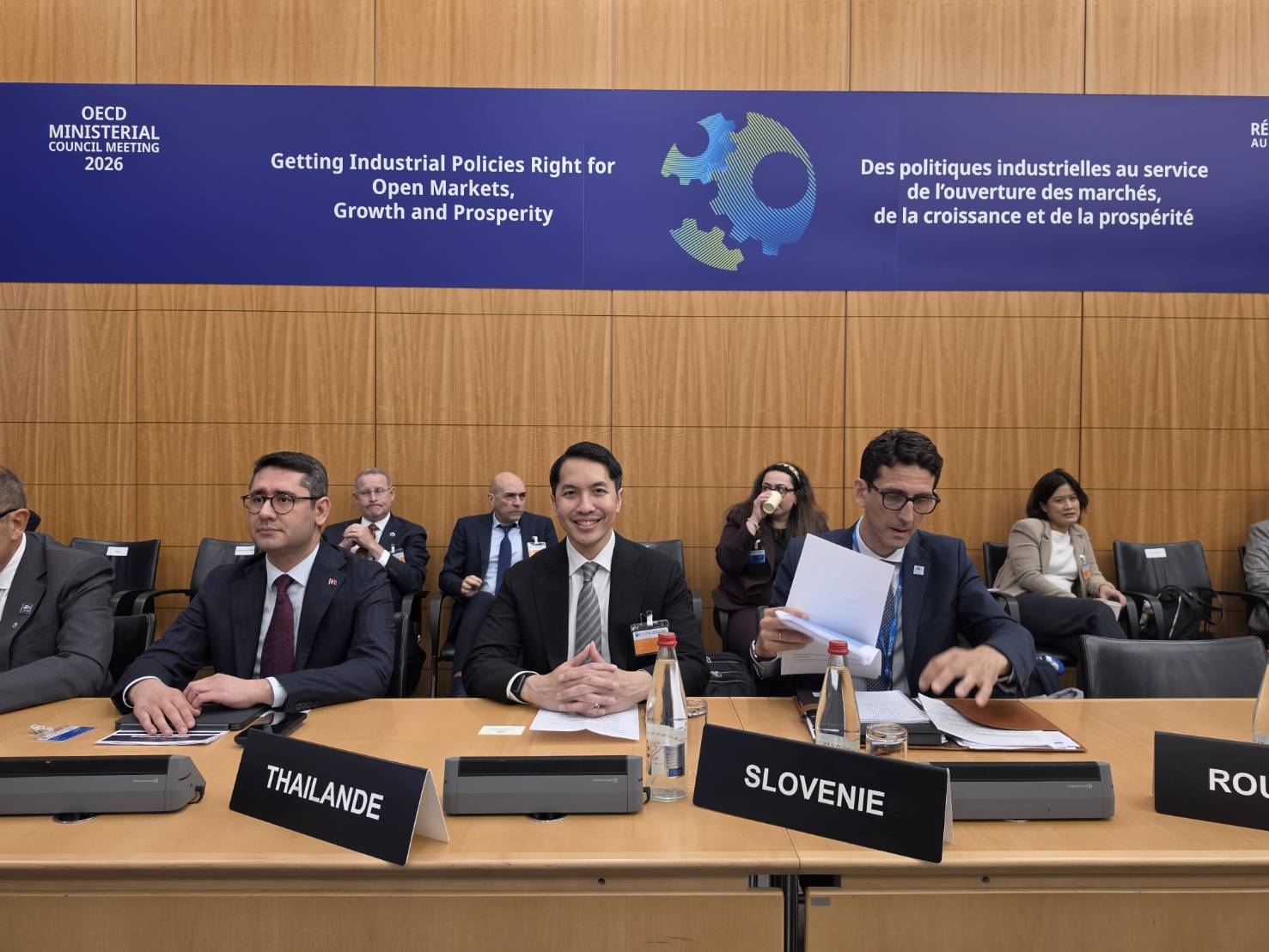
Mr. Santitarn Sathirathai, Vice Minister for Finance, attended the 2026 Organization for Economic Co-operation and Development (OECD) Council at Ministerial Level (MCM) Meeting (the Meeting). He also held bilateral discussions with representatives from the Republic of Lithuania, the Republic of Singapore, the Republic of Indonesia, and senior OECD executives between June 3-4, 2026, in Paris, French Republic.
The Meeting was held under the theme “Getting Industrial Policies Right for Open Markets, Growth and Prosperity” to discuss industrial policies aimed at promoting competitiveness, economic resilience, productivity enhancement, and innovation-driven growth amidst global structural economic shifts.
The OECD plays a crucial role in supporting such actions based on data and empirical evidence, as well as promoting cooperation and experience sharing among member countries and partners. Participation in this meeting served as a significant opportunity to reflect Thailand’s role in the international economic arena, both as a country progressing through the OECD accession process and as a middle-power nation adapting to an increasingly volatile world. The Ministry of Finance utilized this platform to present the “4T” approach for disciplined fiscal policy to accelerate energy transition, enhance competitiveness, and establish new green industries. Furthermore, bilateral talks were held with senior OECD officials, ASEAN member states, and non-regional partners to expand economic cooperation in new dimensions, with key achievements summarized as follows:
1. Thailand’s Role in the OECD The Vice Minister for Finance represented Thailand in presenting the country’s vision during the session on “Fiscal Sustainability and Industrial Policy.” He noted that Thailand is turning energy challenges into opportunities to restructure the economy, accelerate energy transition, strengthen economic security, enhance competitiveness, and build green industries simultaneously. Thailand aims to address these challenges by restructuring the economy to accommodate new technological evolutions, reducing dependence on energy imports, and restoring its fiscal position.
He presented fiscal policy guidelines under the “4T” strategy: (1) Target: setting clear objectives; (2) Transition: accelerating the shift; (3) Transform: upgrading economic structures and the manufacturing sector; and (4) Transparency: promoting transparency and governance. These pillars aim to increase public spending efficiency, strengthen energy security, enhance national competitiveness, and support robust, sustainable long-term economic growth. This concept was well-received by the participants.
The meeting discussed approaches to designing and implementing industrial policies that ensure fiscal sustainability. The focus was on managing rising public expenditure pressures while supporting economic growth, increasing productivity, and strengthening long-term economic resilience, particularly as the world faces various security risks, including energy security and geopolitical security.
2. OECD Accession
The Vice Minister for Finance held bilateral discussions with senior OECD executives across various fields to exchange views and reiterate Thailand’s intent to proceed with OECD membership. He confirmed that OECD accession will be a vital mechanism for driving structural reforms, strengthening governance, and elevating regulatory standards, data collection, and transparency to align with international standards. It will also support Thailand’s long-term sustainable growth in the following areas:
- 2.1 Mr. Nicolas Pinaud, Deputy Director of the OECD Directorate for Financial and Enterprise Affairs: The OECD expressed its readiness to closely support Thailand on key issues such as financial market development, state-owned enterprise governance, investment promotion, and anti-corruption, which will serve as vital mechanisms for driving the country’s structural reforms. The Thai side reaffirmed its commitment to completing the OECD accession process by 2028.
2.2 Ms. Manal Corwin, Director of the OECD Centre for Tax Policy and Administration: Discussions focused on utilizing the OECD accession process as a tool to accelerate national reforms alongside developing efficient tax policies to stimulate the economy and generate government revenue. This includes promoting investment linked to economic activities, reducing regulatory barriers, and upgrading digital tax systems. Both parties agreed to continue technical cooperation to support sustainable economic growth and enhance Thailand’s long-term competitiveness.
2.3 Mr. Stefano Scarpetta, Chief Economist of the OECD: Views were exchanged on global economic trends and key challenges countries are facing amidst energy and geopolitical uncertainties. Furthermore, both sides discussed approaches to strengthening economic resilience, enhancing productivity, and utilizing digital technology and Artificial Intelligence (AI) to improve public sector efficiency. This aims to promote economic opportunities for citizens and small entrepreneurs, as well as develop more efficient welfare systems. The OECD commended the close cooperation with Thailand in preparing the 2025 Thailand Economic Survey and confirmed its readiness to provide ongoing support for Thailand’s structural reforms and OECD accession process.
3. Promoting Cooperation within ASEAN
Thailand has pushed for closer cooperation with key ASEAN nations to cope with a more volatile and uncertain world, particularly in new dimensions such as economic security, energy, food, digital finance, and ASEAN’s role in the global economic arena. This also links to Thailand’s hosting of the 2026 IMF–World Bank Annual Meetings. Discussions were held with ministerial representatives from ASEAN member states as follows:
- 3.1 Ms. Grace Fu, Minister for Sustainability and the Environment and Minister-in-charge of Trade Relations of the Republic of Singapore: Views were exchanged to promote cooperation in economic transition, clean energy, climate finance, and the interconnection of energy infrastructure within the ASEAN region. Discussions also covered promoting investment in renewable energy and driving the circular economy. Additionally, both sides explored avenues for cooperation in digital payment systems, trade facilitation, and regional economic connectivity. Both parties reaffirmed their commitment to advancing Thailand–Singapore cooperation and collaboration under the ASEAN framework to be continuous, tangible, and mutually beneficial. This comes as Thailand prepares to host the 2026 IMF-World Bank Group Annual Meetings in October 2026, while Singapore will serve as the ASEAN Chair in 2027, followed by Thailand the following year. The discussions emphasized the role of middle powers and regional international cooperation in addressing the challenges of an increasingly volatile and complex global economy.
3.2 Mr. Juda Agung, Deputy Governor of Bank Indonesia (representing the Republic of Indonesia): Both sides agreed on the importance of elevating cooperation between Thailand and Indonesia as the largest economies in ASEAN amidst the challenges of global economic shifts. Both countries agreed to push forward cooperation in energy, food security, investment, and digital finance to further strengthen ASEAN’s role in the global economic arena. They also exchanged ideas on presenting key ASEAN agendas during the period when Thailand hosts the Annual Meetings of the International Monetary Fund (IMF) and the World Bank Group in October 2026.
4. Seeking New Partnerships
Amidst high global uncertainty and geopolitical conflicts, Thailand needs to seek new trade and investment partners. During the meeting, the Vice Minister for Finance met with Mr. Paulius Petrauskas, Vice Minister of the Economy and Innovation of the Republic of Lithuania. They exchanged views on economic development, innovation, and future industries. The Lithuanian side presented its potential as a European hub for technology, innovation, Artificial Intelligence (AI), biotechnology, and green energy, expressing interest in increasing investment in the Asia-Pacific region. Meanwhile, the Thai side shared approaches for industrial upgrading, promoting the green economy, and applying technology to enhance national competitiveness. Both sides agreed that Thailand and Lithuania have the potential to further cooperation in trade, investment, technology, and innovation, as well as connecting supply chains between Asia and Europe in the future.
Story and Photos: International Economic Policy Division, Fiscal Policy Office